

The week before your thesis defense is the most crucial period in your academic journey. It's not because you have to rewrite your thesis from scratch, but because all preparations — documents, slides, mental, and technical — must be locked in a short time. This article is designed as a daily guide you can follow step by step.
Why the Last Week Before the Defense is Crucial
The last week is not the time to learn new things. This is a consolidation phase — ensuring everything you've worked on for months can be presented well in front of the examiners. Small mistakes at this stage, like missing documents or messy slides, can significantly impact the defense outcome.
Three Stages of Thesis Defense You Must Understand
In general, a thesis defense consists of three main stages:
- Presentation — Students present a summary of their research, usually 10–20 minutes depending on the program's policy.
- Q&A — The examiners ask critical questions about the methodology, findings, and relevance of the research.
- Examiners' deliberation — Examiners discuss privately to determine the grade and pass status, including whether revisions are needed.
Understanding these three stages is important so you can allocate your preparation energy appropriately. Many students focus too much on slides and neglect Q&A practice, even though the second stage often becomes the main determinant of assessment.
Common Fatal Mistakes in the Last Week
Some of the most common mistakes in the last week include:
- Submitting administrative documents late, causing the defense to be postponed
- Creating new slides from scratch instead of refining existing ones
- Not practicing answering questions orally, only rereading the thesis
- Excessive staying up late, leading to physical and mental exhaustion on the big day
- Ignoring technical checks like internet connection or file compatibility
How to Read This Article: Use as a Daily Checklist
This article is organized by day, not abstract topics. You can read it all at once from start to finish, or jump directly to the day relevant to your current position. In each section, there are concrete points you can immediately check off as a checklist.
Days 1–2: Ensure All Administrative Documents Are Complete
Administration is the foundation. Without complete documents, your defense can be postponed even if your thesis is academically perfect. Prioritize this on the first day.
Mandatory Documents to Submit Before the Defense
Although each institution has different requirements, the following documents are generally required in almost all programs:
- Defense registration form (filled and signed by the advisor)
- Thesis approval/endorsement sheet from the advisor
- Plagiarism check proof (Turnitin or iThenticate) with results below the tolerance limit
- Temporary transcript
- Proof of no outstanding financial obligations
- Recent passport photo (size and background according to faculty requirements)
- Copies of the thesis in the specified number (printed and/or digital)
- Active Student ID Card (KTM)
Make sure you download the latest forms directly from your program's website or secretariat, as old forms are often not accepted.
Document Submission Deadline: Don't Let Your Defense Be Postponed
Administrative documents for the defense generally must be submitted 3–7 working days before the defense date. Some programs even set a 10-working-day deadline to allow time for verification. Do not assume this deadline is flexible — the secretariat usually cannot accommodate last-minute submissions.
Contact your program's secretariat on the first day of this week to confirm the deadline and the latest document list. Save the secretariat's contact number on your phone for easy access.
Check Academic Status in SIAK/SIAKAD and Financial Clearance
Many universities in Indonesia use academic information systems such as SIAK, SIAKAD, or similar platforms. Make sure you log in and verify:
- Current semester KRS status is registered
- No grades are pending from prerequisite courses
- Financial status shows no outstanding obligations
- Personal data (name, student ID, program) is correct
If there are data discrepancies, report them immediately to the academic section as the correction process can take several days.
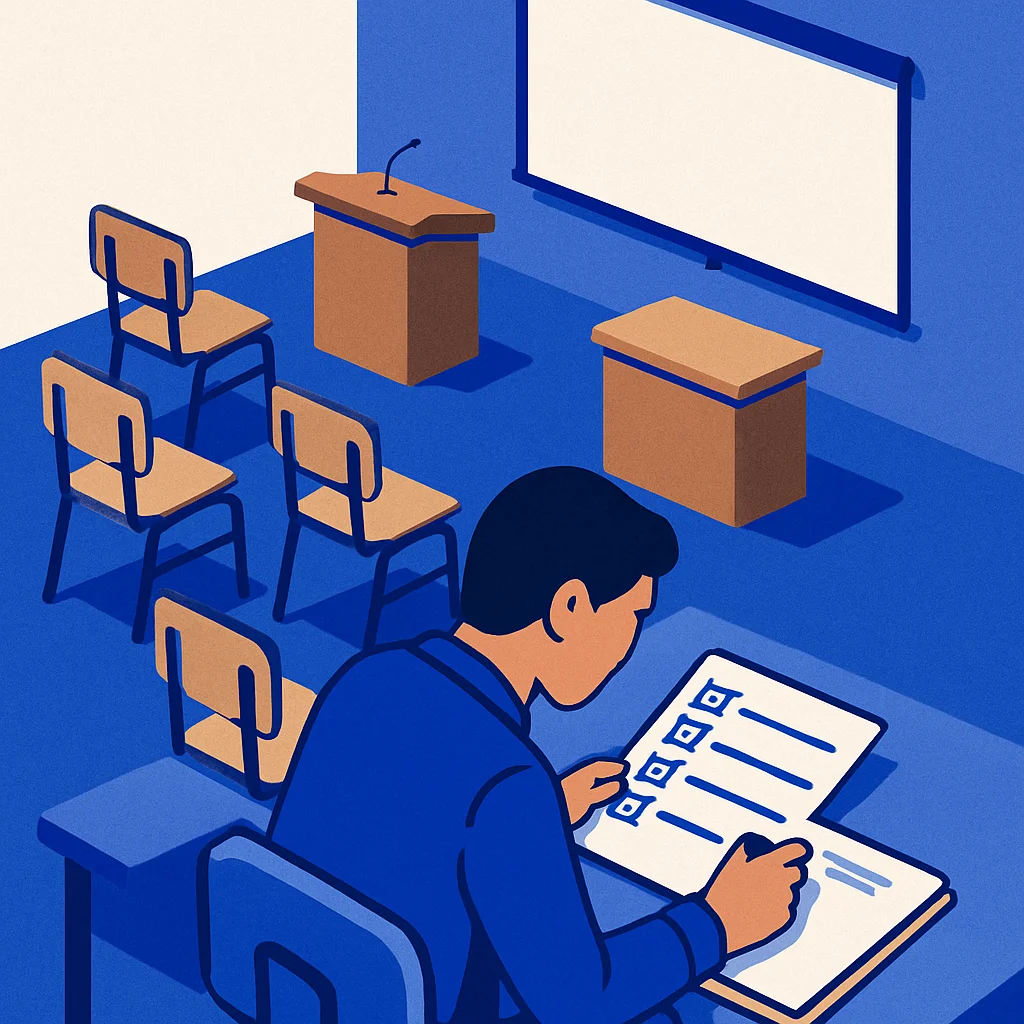
Days 2–3: Finalize Effective Presentation Slides
Slides are not just visual aids — they are communication tools that should guide the examiners to understand your research in a short time. On the second and third days, focus on finalization, not re-creation.
Recommended Thesis Defense Slide Structure
An effective slide structure for a thesis defense generally follows this flow:
- Title page — Thesis title, name, student ID, program, year
- Background & problem statement — Why is this research important?
- Research objectives — What do you aim to achieve?
- Brief literature review — Key theoretical foundation (not all references)
- Methodology — Research design, population/sample, instruments, analysis
- Research findings — Main data in tables or graphs
- Discussion — Interpretation of results and their relation to theory
- Conclusion & recommendations — Answers to the problem statement
- References — Main references only
- Closing & thanks
How Many Slides Are Ideal for a 15–20 Minute Presentation?
Based on common thesis defense rules applied in various faculties, the presentation session usually lasts 15–20 minutes. With this duration, the ideal number of slides ranges from 12–18 slides — enough to convey the main points without rushing or rambling.
The practical rule: allocate about 1–1.5 minutes per slide. If you have more than 20 slides for a 15-minute presentation, it's a signal that some content needs trimming.
Visual Tips: Avoid Text-Heavy Slides That Make Examiners Sleepy
Examiners read your thesis before the defense. Slides that merely transfer paragraphs from the thesis to PowerPoint add no value. Use the following principles:
- One main idea per slide — don't combine two different concepts on one page
- Use charts and tables for quantitative data, not raw numbers in paragraphs
- Minimum 24pt font for main text to be readable from a distance
- High color contrast — avoid gray text on a white background
- Limit bullet points to a maximum of 4–5 points per slide
Days 3–5: Practice Answering Examiners' Questions
This is the most underestimated part and often determines the defense outcome. The ability to answer questions orally is very different from the ability to write a thesis.
Types of Questions Commonly Asked by Examiners
Based on common thesis defense experiences in various programs, examiners' questions usually fall into the following categories:
- Conceptual questions — "Why did you choose theory X and not theory Y?"
- Methodological questions — "How did you ensure the validity of your instruments?"
- Results questions — "What are the implications of these findings for practice in the field?"
- Critical questions — "What are the limitations of your research and how do they affect generalization?"
- Reference questions — "Who are the main figures that form the basis of your theory?"
Prepare answers for at least 10–15 potential questions from each category above.
Strategies for Answering Questions Beyond the Thesis Text
Scenario: An examiner asks about recent developments in your field that you did not cover in your thesis. How do you respond?
The right strategy is not to pretend to know, but to answer honestly and structured:
- Acknowledge your research limits: "In this study, I limited the scope to period X because..."
- Connect with what you know: "However, based on the literature I read, the trend shows..."
- Show academic awareness: "This becomes one of the recommendations for further research."
Examiners do not expect you to know everything. They assess your thinking process, not memorization.
Simulation Practice: Why Practicing Alone Is Not Enough
Rereading your thesis in your room is very different from answering questions under pressure. Practicing alone has limitations because you don't get unexpected questions. Ideally, do simulations with:
- Your advisor or fellow final-year students
- Study groups that can act as examiners
- AI-based simulation platforms that can dynamically ask questions
Practice with AI? Try Sidangin's defense simulation — free for the first 5 minutes to experience a realistic Q&A format simulating examiners' questions.

Days 5–6: Mental Preparation and Anxiety Management
Technical preparation without mental preparation is an incomplete foundation. Unmanaged anxiety can make all the practice you've done not translate well on the big day.
Why Nervousness Before the Defense Is Normal — and How to Manage It
Feeling nervous before the defense is a normal physiological response. The nervous system responds to important situations by increasing alertness — this can actually help you perform more focused if managed correctly. Problems arise when anxiety turns into paralyzing panic.
Some proven strategies that help:
- Reframe perspective — The defense is an opportunity to showcase your hard work, not a test to bring you down
- Focus on the process, not the outcome — Concentrate on what you can control: preparation and how to answer
- Avoid comparing yourself to others' defense experiences that may not be relevant to your situation
Breathing Techniques and Rest That Prove Helpful
Diaphragmatic breathing technique (4-7-8: inhale for 4 seconds, hold for 7 seconds, exhale for 8 seconds) is proven effective in reducing acute stress response. Do 3–5 cycles before entering the defense room.
For rest, ensure you sleep at least 7 hours the night before the defense. Staying up late to "learn more" on the last night is counterproductive — a tired brain cannot process and communicate information optimally.
Building Confidence by Knowing Your Work
The most solid confidence comes from one source: you are the person who knows your research best. Examiners read your thesis in limited time; you worked on it for months.
On the fifth and sixth days, take time to reread your thesis — not to memorize, but to refresh your memory about the research decisions you made and why. This will help you answer questions more naturally and confidently.
Day 7 (D-Day): Technical Checklist Often Overlooked
Defense day is not the time to learn new things. It's time for execution. Focus on technical aspects that are often overlooked because they are considered trivial.
Thesis Defense Attire: General Rules and Faculty-Specific Requirements
Dress codes for thesis defense vary between institutions and even between faculties within a university. In general:
- Men: Long-sleeved white shirt, dark trousers, formal shoes. Some faculties require a suit or blazer.
- Women: Formal blouse or kebaya, skirt/trousers, closed shoes. Some programs require hijab-wearing students to use specific colors.
Check specific requirements in the academic guidebook or your program's website. Do not assume dress codes are the same as friends from different faculties.
File Preparation, Equipment, and Anticipating Technical Issues
D-Day technical checklist:
- Presentation file saved on at least 2 different media (flash drive + cloud/email)
- File in compatible format (.pptx and .pdf as backup)
- Laptop fully charged, charger brought
- Pointer/clicker available (if needed)
- Printed thesis copies bound according to requirements
- Arrive at the location at least 30 minutes before the defense schedule
- Secretariat and advisor contact numbers saved on the phone
Online Defense via Zoom or Google Meet: Additional Challenges to Anticipate
Online defenses have their own technical challenges that need to be anticipated from D-1:
- Internet connection: Use a wired connection (LAN) if possible, or ensure stable WiFi signal. Prepare phone hotspot as backup.
- Lighting: Ensure your face is clearly visible — light from the front, not from behind.
- Background: Use a neutral virtual background or ensure your physical background is neat and professional.
- Audio: Test microphone and speaker on D-1. Use a headset for better audio quality.
- Screen sharing: Practice screen sharing on the platform used to avoid panic when the defense starts.
Conduct a complete technical test (dry run) on D-1 with friends or family members.
Differences in Defense Rules Across Indonesian Campuses You Need to Know
Indonesia has hundreds of higher education institutions with diverse defense policies. Understanding these differences is important so you don't assume your friend's experience at another campus applies to you.
Thesis Defense Terms in Various Institutions: Munaqasyah, Comprehensive Exam, and Others
The term "thesis defense" itself is not uniform across Indonesia:
| Term | General Context |
|---|---|
| Thesis Defense | Common term in most public and private universities |
| Munaqasyah | Commonly used in Islamic higher education institutions (UIN, IAIN, STAIN) |
| Comprehensive Exam | Some programs that combine theory and thesis exams |
| Final Program Exam | Used in some vocational and professional programs |
| Colloquium | Some postgraduate and research programs |
These term differences are often accompanied by differences in procedures, number of examiners, and assessment weights.
National Standards vs Internal Program Policies (Referring to SN-Dikti Kemendikbudristek)
Nationally, higher education in Indonesia is regulated by the National Higher Education Standards (SN-Dikti) from Kemendikbudristek. SN-Dikti sets graduate competency standards and learning processes but gives autonomy to each higher education institution to determine the final evaluation mechanism, including thesis defense.
This means the technical defense policies — duration, number of examiners, assessment format, revision deadlines — are entirely determined by each institution and even program. Always refer to your program's academic guidebook as the main reference.
Illustration: A student transferring from a program at one university to another may be surprised to find that the "standard" procedure they assumed is very different at the new institution.
After the Defense: Revision Process and Final Thesis Submission
The defense is over, but your task is not. The post-defense process is equally important to ensure your graduation is officially recorded.
How Long Is the Post-Defense Revision Deadline?
The post-defense revision deadline varies greatly between institutions. Based on common practice in various programs:
- Minor revisions: Usually 1–2 weeks after the defense
- Major revisions: Can reach 1–3 months, depending on the examiners' decision
- Revisions with a re-defense: Rescheduled after revisions are completed and approved
Immediately meet with your advisor after the defense to get a clear and written list of revisions. Do not rely on verbal memory alone.
Final Thesis Submission Flow to Graduation Registration
After revisions are approved, the general flow to go through is:
- Thesis revisions approved and signed by all examiners and advisors
- Final thesis submission to the library (printed and/or digital)
- Submission of graduation documents to the academic section
- Issuance of Temporary Graduation Certificate (SKL)
- Graduation registration according to the schedule set by the university
- Issuance of official diploma and transcript
Each stage has its own deadline. Delays in one stage can shift your graduation schedule to the next period.
Temporary Graduation Certificate: When and How to Manage It
The Temporary Graduation Certificate (SKL) is an important document often needed to apply for jobs or scholarships before the official diploma is issued. SKL can usually be managed after all graduation documents are complete and verified by the academic section.
The SKL issuance process generally takes 3–14 working days depending on the institution. Ask the specific procedure to your program's academic section immediately after the defense is over.
Conclusion
Preparing for a thesis defense in a week is not about doing everything at once — it's about doing the right things at the right time. Days 1–2 for administration, days 2–3 for slides, days 3–5 for Q&A practice, days 5–6 for mental preparation, and day 7 for technical execution.
What most distinguishes students who appear confident in the defense from those who do not is not intelligence or thesis quality alone, but the quality of preparation — especially practicing answering questions orally. Use every available resource, including friends, advisors, and technology like Sidangin for more realistic simulations.
You have been working on this research for months. This week is your chance to showcase the results as best as you can. Good luck!
Frequently Asked Questions
How many days before the thesis defense should I submit administrative documents to the secretariat?
Based on common practice in various programs in Indonesia, administrative documents for the defense generally must be submitted 3–7 working days before the defense date. Some programs set a longer deadline, up to 10 working days. Confirm directly with your program's secretariat as this deadline is not flexible and delays can cause the defense to be postponed to the next period.
What are the usual questions asked by examiners during a thesis defense and how to prepare the answers?
Examiners generally ask questions around five areas: reasons for topic and theory selection, methodology validity, results interpretation, research limitations, and practical implications of findings. The best way to prepare answers is to make a list of 10–15 potential questions from each area, then practice answering them orally — not just in writing. Practicing with friends or AI simulations is far more effective than rereading the thesis.
What is the similarity tolerance limit for Turnitin or iThenticate applicable in Indonesian universities?
The similarity tolerance limit varies between institutions and even between programs. In general, the limit often applied ranges from 15–30% for undergraduate theses, but some programs set a stricter limit at 10–15%. Some institutions also differentiate limits for overall similarity and single-source similarity. Check the specific provisions in the academic guidebook or ask directly to your advisor and secretariat.
How to prepare for an online thesis defense to avoid technical issues?
Conduct a complete technical test on D-1: test internet connection (use LAN if possible), ensure microphone and camera work well, practice screen sharing on the platform used (Zoom or Google Meet), and prepare phone hotspot as a backup connection. Save the presentation file in the cloud (Google Drive or OneDrive) so it can be accessed from another device if the laptop has issues. Also, ensure room lighting is sufficient and the background looks neat and professional.
What should I do if I can't answer an examiner's question during the defense?
Honesty and structure are the best responses. You can say: "This question is interesting and beyond the scope I researched in depth. Based on what I understand, [your best answer], but I need to study further to provide a more comprehensive answer." Examiners assess your thinking process, not memorization. Answering honestly and showing academic awareness is far better than making up inaccurate answers.


