

The day of your thesis defense is just around the corner. You've reread chapter after chapter, memorized your methodology, and prepared your presentation slides. But as soon as you imagine sitting in front of the examiners, your heart starts to race, and your palms feel clammy. You're not alone — and more importantly, you're not experiencing anything wrong.
This article serves as a practical psychological guide to help you understand the roots of anxiety during the defense, change your perspective on it, and apply concrete techniques that can be used immediately — from the night before the defense to the moments you sit in the presentation chair.
Why You Feel Nervous During the Defense — and It's Normal
Fight-or-Flight Response: Not a Sign You're Unprepared
When you feel nervous before the defense, your body is actually working exactly as evolution designed it. The autonomic nervous system detects situations perceived as "threatening" — in this case, public evaluation — and triggers the fight-or-flight response. The result: increased heart rate, shorter breaths, and thoughts racing faster than usual.
This response has nothing to do with how well you understand your thesis. It's the same biological mechanism experienced by seasoned presenters, professional athletes, and even world-class public speakers before they perform. What sets them apart is not the absence of nervousness, but how they manage it.
Why Students Who Understand the Material Can Still Go Blank
One of the most confusing experiences during the defense is when you suddenly can't recall something you actually know well. This is not a coincidence and not a sign of incompetence. When cortisol and adrenaline spike due to acute stress, the working memory function in the prefrontal cortex experiences temporary disruption.
This means the more panicked you are when you go blank, the harder it is for your brain to access stored information. Understanding this mechanism is crucial because it helps you avoid worsening the situation with a panicked reaction that prolongs the memory block.
Mild Nervousness Is an Ally, Not an Enemy (Yerkes-Dodson Law)
In psychology, there's a concept known as the Yerkes-Dodson Law: optimal performance doesn't occur when you're completely relaxed, but when you're at a moderate level of arousal. Mild nervousness actually makes you more alert, more focused, and sharper in responding to questions.
Problems arise when anxiety exceeds that threshold and turns into panic. The goal of this guide is not to eliminate nervousness entirely but to help you keep anxiety within a productive zone.
Mindset Mistakes That Worsen Anxiety
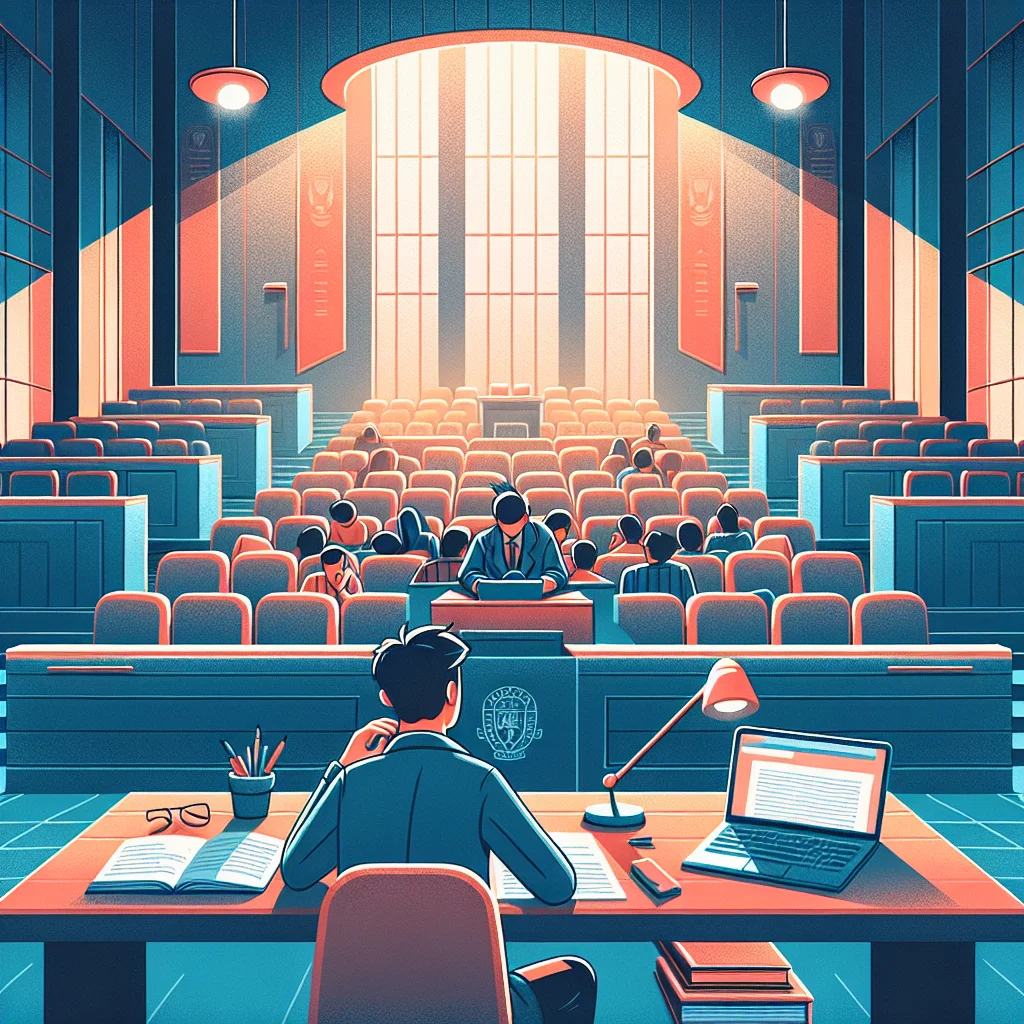
Myth: "Nervousness Means the Thesis Is Not Good"
Many students unconsciously believe that nervousness is a signal that something is wrong with their research. This belief is dangerous because it creates a vicious cycle: you feel nervous, then interpret the nervousness as evidence of unpreparedness, which makes you even more nervous. In reality, anxiety and thesis quality are two entirely separate things.
Students with the best theses can feel very nervous, while students who appear calm may not necessarily have a deeper understanding. Nervousness is a response to an evaluative situation, not a reflection of your academic value.
The Trap of Trying to Eliminate Nervousness Completely
The anxiety paradox states that the harder you try not to feel nervous, the stronger the nervousness becomes. It's similar to the instruction "don't imagine a red elephant" — the brain can't process negation without first imagining the object. The "don't be nervous" strategy is one that almost always fails.
A more effective approach is acceptance: acknowledging that you're nervous, allowing the sensation to exist without fighting it, and continuing with the presentation. This acceptance, paradoxically, reduces the intensity of anxiety faster than resistance.
Framing the Defense as an Exam vs. Presenting Your Work
How you frame the defense in your mind greatly determines the emotional response that arises. If you view the defense as "an exam where I can fail," the brain will treat it as a threat. If you view it as "a session where I present the results of months of hard work," the brain will treat it as a challenge that can be faced.
This framing shift is not just a motivational trick. Research in cognitive psychology shows that how we define a situation literally changes the brain activation patterns and physiological responses that follow.
Quick Breathing and Relaxation Techniques Before Entering the Defense Room
Diaphragmatic Breathing: How It Works and Practical Steps
Diaphragmatic breathing is one of the fastest and most proven self-regulation techniques to calm the nervous system. When you breathe deeply using the diaphragm (not the chest), you activate the parasympathetic nervous system responsible for the "rest and digest" response — the opposite of fight-or-flight.
The method is very simple:
- Sit or stand with your back straight
- Place one hand on your chest, one hand on your stomach
- Inhale slowly for a count of 4 — make sure your stomach expands, not your chest
- Hold for a count of 4
- Exhale slowly for 6–8 counts
- Repeat 4–6 times before entering the defense room
Do this in the campus corridor or restroom, even 5 minutes before being called in. The effects are felt within minutes.
5-4-3-2-1 Grounding Technique While Waiting for Your Turn
Waiting for your turn to be called is often the most psychologically torturous moment. The mind tends to drift to worst-case scenarios. The 5-4-3-2-1 grounding technique helps bring attention back to the present moment in a concrete way.
Here's how:
- 5 things you can see around you
- 4 things you can touch and feel their texture
- 3 things you can hear right now
- 2 things you can smell
- 1 thing you can taste
This technique works because it forces the brain to process real sensory information, which automatically interrupts the abstract anxious thought spiral.
Body Posture Before the Defense: Standing Tall Is More Than Just Style
Research in body psychology shows that physical posture affects psychological states in both directions. Standing or sitting with an open and upright posture — shoulders back, head straight, chest slightly open — physiologically helps lower cortisol and increase confidence.
Conversely, a hunched posture with shoulders slumped and head down reinforces "threat" signals to the brain. Before entering the defense room, take 2 minutes to stand tall, take a deep breath, and let your body send confidence signals to your mind.
Cognitive Reframing: Change Your Internal Narrative Before the Defense Begins
What Is Reframing and Why This CBT-Based Technique Is Effective
Cognitive reframing is a core technique in Cognitive Behavioral Therapy (CBT) that teaches us to identify and change unhelpful thought patterns. The premise is simple: thoughts influence feelings, and feelings influence behavior. By changing the internal narrative, you can change the emotional response and ultimately your actual performance.
This technique is not about pretending everything is fine. It's about seeing the situation more accurately and proportionally, not through the anxiety lens that tends to dramatize risks.
From "I Will Fail" to "I Am Presenting My Work"
Common internal narratives before the defense are often catastrophic: "I will definitely go blank", "The examiner will definitely fail me", "My thesis is not good enough". These narratives feel real, but rarely reflect reality accurately.
A reframing exercise you can try:
- Identify one negative thought that frequently arises
- Ask: "What concrete evidence supports this thought?"
- Ask: "What evidence contradicts this thought?"
- Reframe the thought into a more balanced and accurate version
Example: "I will definitely go blank" → "I might be nervous, but I've studied this material for months and I know my research better than anyone in the room."
How to Craft Realistic Affirmations, Not Toxic Positivity
Effective affirmations don't mean overly grand statements that you don't believe yourself. Phrases like "I am the best presenter!" can feel hollow and unconvincing to a brain already in critical mode. More effective affirmations are realistic, specific, and believable.
Examples of realistic affirmations for a thesis defense:
- "I've worked on this research for [X] months. I know the material."
- "Nervousness is a sign that this is important to me — and that's normal."
- "I don't have to be perfect. I just need to convey what I know."
- "The examiner wants to see me succeed, not find ways to fail me."
Recovery Strategies When You Go Blank During the Defense

Why Panicking When You Go Blank Worsens the Memory Block
When you go blank during the defense, the first reaction that usually arises is panic — and it's this panic that prolongs the memory block. As explained earlier, acute stress disrupts working memory function. The more you force yourself to remember while panicking, the more the brain "locks" access to that information.
The key to getting out of a memory block is to lower the arousal level first, then try to access the memory. This sounds counterintuitive when you're under pressure, but it's the most psychologically effective approach.
Self-Talk and Grounding Techniques to Regain Focus in Seconds
When you go blank, use the following sequence internally:
- Acknowledge without judgment: Say to yourself, "Okay, I'm blanking. This is normal and will pass."
- Take one breath: One slow deep breath is enough to lower the panic response.
- Brief grounding: Feel the chair beneath you, or the pressure of your feet on the floor. This brings attention back to the present moment.
- Start from what you remember: Answer from the angle you know, let the memory flow naturally.
This entire process can be done in 5–10 seconds without being noticeable to the examiner.
When to Ask for Time — and How to Do It Calmly
Asking for a moment to think is a completely reasonable right during a thesis defense. Experienced examiners understand that this is a sign of a student thinking before speaking, not a sign of ignorance. The important thing is how you ask for it.
Phrases you can use:
- "May I take a moment to think, Sir/Madam?"
- "That's an interesting question. May I organize my answer for a moment?"
- "May I clarify the question first — is it meant that...?" (asking for clarification also gives you time to think)
Avoid long silences without explanation, as that creates an impression of unpreparedness. One short sentence is enough to fill the gap elegantly.
Note: This section focuses on the psychological condition when blanking. For strategies to answer questions that are not in your thesis academically, read our article: [How to Answer Examiner Questions Not in Your Thesis].
Defense Simulation: Mental Practice More Important Than Memorizing Material
Why Practicing Alone in Your Room Is Not Enough
Rereading your thesis and memorizing key points is necessary preparation, but not sufficient. A thesis defense is a social situation involving evaluative pressure, unexpected questions, and room dynamics that can't be simulated just by reading alone. The brain needs to be trained to function under conditions resembling the real situation.
The relevant concept here is habituation — the process by which repeated exposure to anxiety-triggering stimuli gradually reduces the intensity of the response. The more you practice in conditions similar to the defense, the more familiar the situation becomes to your nervous system, and the smaller the fight-or-flight response triggered.
How to Create Mock Presentation Sessions That Resemble a Real Defense
To create an effective simulation, pay attention to the following elements:
- Environment: Do it in a room different from your bedroom, ideally with a formal table and chairs
- Clothing: Wear the clothes you will wear during the defense — this helps the brain enter "defense mode"
- Audience: Ask friends, family members, or anyone to sit as "examiners" and ask questions
- Unexpected questions: Ask the "examiners" to pose questions you didn't anticipate beforehand
- Record yourself: Video recordings help you see body language and speech pace objectively
- Post-session evaluation: Discuss what went well and what needs improvement
Conduct at least 2–3 simulation sessions like this before D-Day.
Sidangin as a Practice Partner: AI-Based Q&A Simulation
Not all students have easy access to friends who can be invited to simulate at any time, or supervisors available for additional practice sessions. This is where technology can be a very practical solution.
Sidangin is an AI-based platform specifically designed to help Indonesian students practice thesis defenses. You can conduct Q&A simulations anytime — even at midnight — with questions relevant to your research field. The main benefit is not just mastering the content, but psychological habituation: the more you practice answering questions in a format resembling the defense, the more accustomed your nervous system becomes to the pressure of the situation. This is a concrete step you can start today, even before you feel "ready."
Night Before the Defense Preparation: What to Do and Avoid
Avoid Marathon Studying: Why Fatigue Worsens Anxiety
The temptation to study late into the night before the defense is real, but it's one of the most counterproductive decisions you can make. Physical fatigue directly increases emotional reactivity and decreases self-regulation capacity. This means you'll be more prone to panic, harder to think clearly, and more susceptible to memory blocks the next day.
On the night before the defense, material you haven't mastered won't be mastered overnight. What you can do is ensure your brain and body are in the best condition to access everything you've learned over the months.
Helpful Night Rituals: Sleep, Eat, and Non-Academic Preparation
Some things you should do the night before the defense:
- Have a sufficient dinner: Avoid overeating or eating too little — both can disrupt sleep quality
- Prepare all physical equipment: Clothes, documents, laptop, charger — finish everything before 9 PM so there's nothing left to think about
- Limit screen time: Reduce exposure to social media and news that can trigger additional anxiety
- Engage in light relaxation activities: Take a warm bath, read a non-academic book, or listen to calming music
- Sleep at a reasonable hour: Aim for 7–8 hours of sleep — this is not a luxury, it's a performance necessity
Short Mental Checklist Before Sleep to Prevent Racing Thoughts
One reason the mind struggles to calm down before sleep is that the brain feels there are still "unfinished" things. You can help the brain feel more at ease by doing a short brain dump before bed:
- Write down 3 things you've prepared well
- Write down 1–2 things you still want to remember tomorrow (not to study, just to note)
- Write down one realistic affirmation you'll bring to the defense
Ending the night with concrete notes like this helps the brain "close open tabs" and switch to rest mode.
Body Language and Speaking Style That Build Confidence
Posture, Eye Contact, and Gestures: Two-Way Signals Between Body and Mind
Body language is not just about the impression you give to the examiner — it's also about the signals you send to yourself. Sitting upright with open shoulders, making natural eye contact (not staring), and using controlled hand gestures all contribute to the confidence you feel internally.
Some practical guidelines:
- Eye contact: Direct your gaze to the examiner speaking, but don't stare continuously — occasionally shift to slides or notes naturally
- Hands: Place them on the table or use them for gestures that support explanations, avoid crossing arms over the chest
- Head: Nod when listening to questions — this shows you're actively processing, not freezing
Speaking Pace and Pauses: How to Sound Calm Even When Your Heart Is Racing
Anxiety almost always makes people speak faster than usual. This is an automatic response you need to be aware of and actively control. Speaking too fast not only makes it difficult for the examiner to follow but also sends anxiety signals that you can feel yourself.
Pauses are a very powerful tool. Pausing briefly before answering a question doesn't appear as a weakness — it actually shows that you're thinking before speaking. Train yourself to take one short breath before starting to answer each question.
Facing the Formal Atmosphere of the Defense Room: Context of Defense in Indonesia
Thesis defenses in Indonesia have a fairly distinctive formality: there's a clear hierarchy between students and examiners, there are opening and closing protocols, and there are certain expectations about speaking politely yet confidently. Understanding this context beforehand helps you not be surprised by the room's atmosphere.
Some things to note:
- Use appropriate salutations: "Sir/Madam [name/title]" when answering specific questions from a particular examiner
- If you disagree with an examiner's comment, express it with a respectful sentence: "Thank you for your input, Sir/Madam. Allow me to explain the considerations behind that decision..."
- Listen to the question until it's finished before starting to answer — interrupting the examiner is a mistake to avoid
Conclusion
Feeling nervous during a thesis defense is not a sign of weakness, not a sign your thesis is lacking, and not something you should fight tooth and nail. It's a normal biological response to an important evaluative situation — and like all biological responses, it can be managed with the right strategies.
Three main pillars you need to hold onto:
- Thorough preparation: Master your material, but also prepare your physical and mental condition — especially the night before the defense
- Simulation practice: Habituation through practice resembling real conditions is far more effective than just memorizing
- Self-regulation techniques on D-Day: Breathing, grounding, reframing, and body language are tools you can use anytime
If you want to start with a concrete step today, try using Sidangin for your first Q&A simulation session. No need to wait until you feel "ready" — it's the practice that will make you ready.
Frequently Asked Questions
Is it normal to feel very nervous even after preparing the thesis thoroughly?
Absolutely normal. Anxiety levels are not directly proportional to readiness levels. You can master the material very well and still feel nervous because the defense is a public evaluative situation that biologically triggers the fight-or-flight response. What you need to do is not eliminate nervousness, but manage it to stay in a productive zone.
How long before the defense should I start practicing breathing techniques or presentation simulations?
For breathing and grounding techniques, you can start practicing anytime — even weeks before the defense to be accustomed to when needed. For presentation simulations, ideally start 1–2 weeks before D-Day with at least 2–3 practice sessions resembling real defense conditions. The earlier you start, the greater the habituation benefits you gain.
What should I do if I completely blank and can't remember the answer at all when the examiner asks?
Don't force yourself to answer while panicking. Take one deep breath, do a brief grounding (feel the chair or floor beneath you), and calmly say: "May I take a moment to think." Start answering from the angle you remember, and let the memory flow naturally. If you really can't remember, it's better to be honest elegantly than to make up an inaccurate answer.
Can excessive nervousness affect the examiner's assessment of my thesis?
Experienced examiners understand that anxiety is normal and doesn't reflect the quality of the research. What affects the assessment more is how you handle the situation and respond to questions. Focus on managing your anxiety and presenting your work confidently.


